
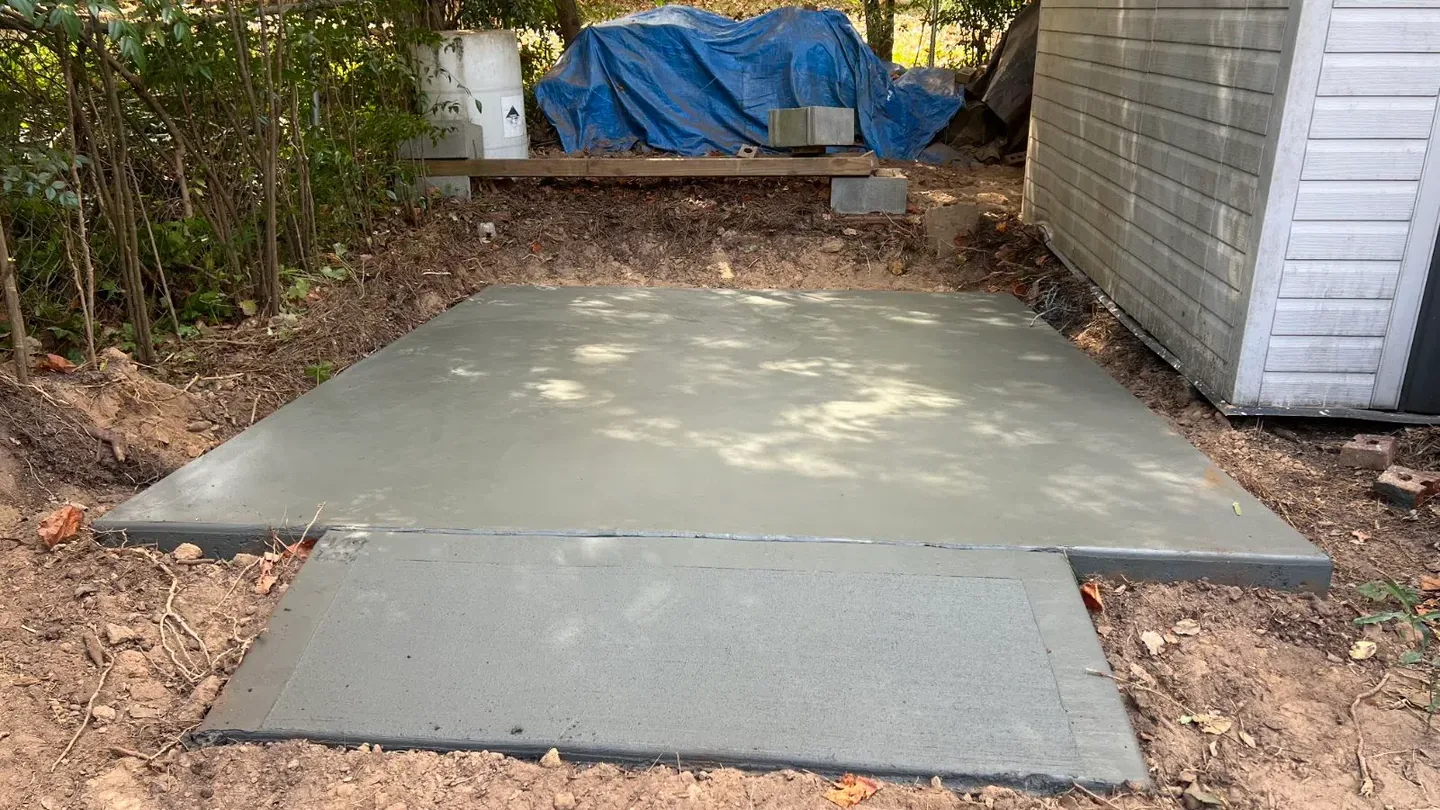
How Much Does a Concrete Pad Cost in Wisconsin?
National cost guides put a plain concrete pad at about $4 to $8 per square foot installed. One guide’s national average is $6.60 per square foot, and most jobs run $4.34 to $7.73. At those rates a 10x10 pad costs $434 to $773. A second guide puts the average 10x10 slab at $600 in 2026.
These are market numbers, not our price list. M.O.E Masonry pours small slabs and pads as part of our concrete work around Racine. The price of a pad turns on its size and thickness and on what goes under it.
What does a concrete pad cost by size?
The table below comes from the first guide’s size table.
| Pad size | Square feet | Typical range | Average |
|---|---|---|---|
| 8x8 | 64 | $278 to $495 | $422 |
| 10x10 | 100 | $434 to $773 | $660 |
| 10x12 | 120 | About $520 to $930 (our math) | About $790 (our math) |
| 12x12 | 144 | $625 to $1,113 | $950 |
| 12x16 | 192 | About $830 to $1,480 (our math) | About $1,270 (our math) |
| 12x20 | 240 | $1,042 to $1,855 | $1,584 |
The 10x12 and 12x16 rows are our math: the guide’s per-square-foot range and average times the area.
Prices also move by region. The second guide puts the middle of the country at about $5.35 per square foot. Coastal states run as high as $8.50. None of the three guides lists Wisconsin on its own.
What drives the price of a concrete pad?
Size and thickness. Most slabs are 4 to 6 inches thick, a third national guide says. The first guide puts a 4-inch slab at $5.35 per square foot on average. A 6-inch slab averages $6.19. Many installers charge by the cubic yard, and one yard covers about 81 square feet of a 4-inch slab. So a 10x10 pad at 4 inches takes a little over one yard.
The gravel base and site prep. A gravel base adds $1 to $3 per square foot in the third guide. A slab will not settle well on hilly or bumpy ground, the first guide says. So the spot is graded first.
Wire mesh or rebar. In the first guide, wire mesh adds about $0.35 per square foot and a vapor barrier $0.50. The mesh helps hold the slab together when it does crack. The second guide puts rebar at $0.50 to $1 more per square foot. A fully reinforced slab can reach $9.29 to $10.04 per square foot in the first guide.
Tearing out an old slab. Concrete removal runs $3 to $8 per square foot with disposal, the third guide says. Removing a 10x10 slab costs $300 to $800, depending on the job and how much rebar is inside.
Access for the truck. Pouring straight from the mixer truck costs the least, the second guide says. When the truck cannot reach the spot, the concrete is moved by hand and the price goes up. A pad behind a fence may need wheelbarrows or a pump.
The finish. A broom finish costs $1 to $3 per square foot, or comes in the base price, the second guide says. Decorative finishes cost more and belong to a decorative concrete contractor.
The season. A National Ready Mixed Concrete Association guide sets the cold weather line. It is more than 3 days in a row averaging below 40 degrees F. Fresh concrete should be kept from freezing until it reaches 500 psi, about two days after the pour. Concrete that freezes early can lose more than 50 percent of its potential strength. So a fall pour around Racine is planned around the forecast.
What does a shed pad cost?
The third guide puts a concrete shed foundation at $600 to $4,800 for a 10x10 to 20x20 slab. Most shed slabs are about 4 inches thick and do not usually need reinforcement, it says. The second guide puts an 80 square foot shed slab at $480. The first guide prices a 10x10 shed slab four ways.
| 10x10 shed slab | Average cost |
|---|---|
| 4 inches, no reinforcement | $535 |
| 6 inches, no reinforcement | $619 |
| 4 inches, with mesh wire and a vapor barrier | $620 |
| 6 inches, with mesh wire and a vapor barrier | $704 |
What does a hot tub pad cost?
The third guide puts a hot tub slab at $5 to $10 per square foot, or $500 to $2,500. Other bases on its list are an existing patio, gravel, pavers, a reinforced deck or a plastic spa pad. A filled hot tub is heavy, so check the tub maker’s install guide for the pad it needs. Ask what thickness and reinforcement a quote is based on.
The wiring is a licensed electrician’s work. The third guide puts a dedicated circuit and a GFCI outlet or subpanel at $800 to $1,600. It says the conduit trench costs least when it is dug before the pad goes in.
What about AC unit, generator and grill pads?
Many AC condensers and standby generators sit on a small precast or plastic pad. You buy those ready-made and set them in place. For small, simple projects, the third guide says pre-cast slabs often cost less than pouring on site. The second guide puts pre-cast slabs at $5 to $15 per square foot.
A poured pad fits when the unit maker calls for one or the spot needs an odd size. The gas line and the wiring are other trades’ work. A grill pad or a trash-can pad is priced like any small slab.
When is a concrete pad the wrong answer?
A garage or a heated building is a different job. It usually sits on footings or a block frost wall, not on a floating pad. The building inspector’s office says what your town requires.
Driveways, garage floors, basement floors and concrete patios go to a concrete contractor who does that flatwork every day.
How do you protect a new pad in a Wisconsin winter?
Another National Ready Mixed Concrete Association guide says exterior concrete exposed to freezing should be air-entrained. For freezing and deicers, it says to order 4000 psi concrete. It recommends 6 percent total air when the mix uses 3/4-inch or 1-inch stone.
Keep deicing chemicals off a new pad, and use clean sand for traction instead. Ask what mix a quote is based on.
Do you need a permit for a concrete pad in Wisconsin?
It depends on the town and on what sits on the pad. The Village of Pleasant Prairie lists a detached accessory building and a hot tub among projects needing a permit. Its accessory structure form covers a detached garage, shed, carport, gazebo or pergola.
The third guide says most cities do not require a building permit for an average above-ground hot tub. The building inspector’s office in your town answers permit questions, and we point you there.
How do you get a real number for your pad?
The real number comes from your yard and what will sit on the pad.
M.O.E Masonry is a masonry contractor based in Mount Pleasant on the south side of Racine. We pour small slabs and pads, concrete steps and sidewalks along with the masonry. We work about 40 miles around Racine, in Racine County, Kenosha County and the south side of Milwaukee County.
We look at the job, or you send photos, and we put the quote in writing. See the small concrete work we do, or call or text (262) 744-4688.