
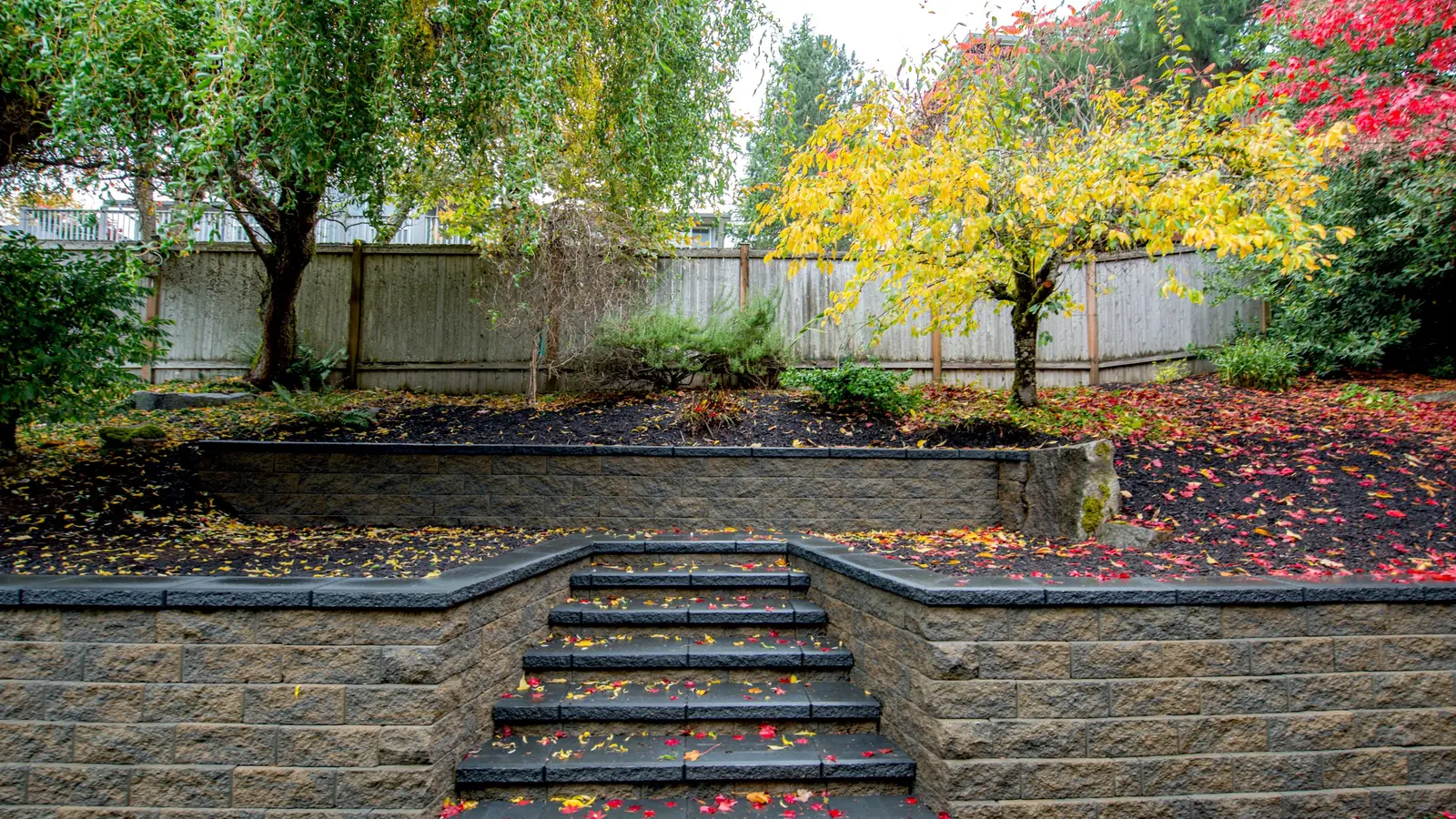
How Much Does a Retaining Wall Cost in Wisconsin?
National cost guides put most retaining walls at about $20 to $65 per square foot of wall face, with materials and labor included. Most homeowners pay $3,500 to $9,400, and one guide puts the national average at $6,300. In another guide, a 50-foot wall that stands 4 feet tall runs about $7,000 to $13,000.
Those are market numbers, not our price list. The guides publish national figures, not Wisconsin prices, so use them as a starting point. For masonry retaining walls around Racine, the real number comes from your slope, your soil and the wall you need.
What does a retaining wall cost per square foot?
Cost guides price a wall by the square foot of its face, which is the length times the height. A wall 25 feet long and 4 feet tall has 100 square feet of face. The ranges below span two national guides and include materials and labor.
| Wall type | Per square foot of wall face | Notes |
|---|---|---|
| Segmental retaining wall block | $15 to $35 | Interlocking block, stacked without mortar |
| Concrete block (CMU) | $15 to $40 | Laid in mortar on a concrete footing |
| Stone or brick face on a block wall | Add $5 to $25 | A veneer over the block core |
| Brick | $17 to $60 | Often a block core with a brick face |
| Natural stone | $20 to $95 | The widest spread, set by the stone |
| Poured concrete | $20 to $45 | For comparison only |
| Timber | $13 to $35 | For comparison only |
Segmental block, concrete block with or without a stone or brick face, and mortared natural stone are masonry walls. Poured concrete and timber walls are built by other trades. They sit in the table so you can compare.
To price a wall per linear foot, multiply by its height. At one guide’s $35 to $65 a square foot, a 2-foot garden wall runs about $70 to $130 per linear foot. A 4-foot wall runs about $140 to $260 per linear foot.
What does a typical retaining wall job cost?
One national guide’s calculator gives these totals at $35 to $65 per square foot.
| Wall length | 2 feet tall | 4 feet tall | 6 feet tall |
|---|---|---|---|
| 10 feet | $700 to $1,300 | $1,400 to $2,600 | $2,100 to $3,900 |
| 25 feet | $1,750 to $3,250 | $3,500 to $6,500 | $5,250 to $9,750 |
| 50 feet | $3,500 to $6,500 | $7,000 to $13,000 | $10,500 to $19,500 |
| 100 feet | $7,000 to $13,000 | $14,000 to $26,000 | $21,000 to $39,000 |
The same guide notes that most retaining wall contractors have a project minimum of $1,500 to $3,000. So a short garden wall can cost more per foot than the table shows. Labor makes up 40 to 60 percent of the total, and site access and the job’s complexity move it most.
What drives the price of a retaining wall?
Height and length. The face area sets the base price. Doubling the height doubles the face, and a taller wall brings more of the costs below with it.
Taking out the old wall. A failed wall has to come out first. National guides put removal at $10 to $20 per square foot of old wall, or $15 to $30 per linear foot, plus disposal.
Drainage. Gravel backfill, a perforated drain pipe at the base and weep holes go in as the wall goes up. One guide says drainage can add as much as $60 to $70 per linear foot.
The footing. A mortared block or stone wall sits on a poured concrete footing. One guide prices footings for taller walls at $18 to $55 per linear foot. For comparison, Wisconsin’s dwelling code puts house footings at least 48 inches below grade (SPS 321.16).
A face, a cap and steps. A stone or brick face over block adds $5 to $25 per square foot in one guide. Cap stones run $5 to $15 apiece. Steps built into the wall add their own line to the quote.
An engineer’s design. Tall walls, and walls with a driveway or a slope above them, often need an engineer’s design. One national guide puts engineering fees at $500 to $2,000 or more.
When does a retaining wall need an engineer or a permit?
Height and load decide most of it. A tall wall, or one that holds up a driveway, a parking pad or a slope, often needs an engineer’s design. In many towns it needs a permit too.
Wisconsin towns write their own rules for retaining walls, so the answer can change at the town line. The building inspector’s office answers permit questions, and we point you there. When a design is needed, the engineer’s plan comes first, and the permit is sorted out before work starts.
Why is drainage not optional in southeast Wisconsin?
Water does most of the damage. One national guide says proper drainage prevents the hydrostatic pressure that makes walls bow and crack. Without a way out, water builds up behind the wall and pushes.
Winter adds frost. NOAA’s climate normals for Racine show the air dropping below freezing and climbing back above it on dozens of days a year. The concrete masonry industry’s technical notes point to heaving caused by water freezing in the soil. That is why footings go below the frost line.
Behind a wall, the fix is to keep the soil from staying wet. Gravel lets water drain, the pipe carries it away and the weep holes let it out. They add to the first bill, and they cost less than rebuilding a wall that failed.
Should you repair or rebuild a failing retaining wall?
Small problems are often repairs. One national guide puts retaining wall repair at $200 to $1,200, depending on what needs fixing. Resetting loose caps or repointing open joints on mortared stone walls is repair work.
A wall that leans, bulges or has slid has moved, often from water and frost behind it. Patching the face does not fix that. The usual answer is to take the failed section down and rebuild it with drainage behind it. One guide puts a full replacement at close to $60 to $70 per square foot.
Block walls follow the same rule. Cracked or spalled units can be replaced, but a wall that moved needs a rebuild. Our concrete block work includes block garden and retaining walls. A tall wall, or one under a driveway, should get an engineer’s look first.
How do you get a real number for your wall?
National ranges get you close. The real number comes from the site: the height and length, the soil, the access and what sits above the wall. Whoever you hire, the quote should spell out the base, the backfill and the drain pipe.
M.O.E Masonry is based in Mount Pleasant on the south side of Racine. We build segmental block, concrete block and mortared stone walls. We look at the job, or you send photos, and we put the quote in writing. See how we build retaining walls that drain, or call or text (262) 744-4688.